
Is a Back House Extension the Right Move for Your Home?
Moving house can be a stressful experience. The viewings, the chain, the stamp duty, the sheer amount of boxes. Most people only seriously consider it when they've run out of road where they are, but more often than not, the real problem isn't the house itself. It's the layout. There isn't enough room, the kitchen is too small, the kids are on top of each other, and the garden just sits there doing nothing useful.
That's usually the point where people start looking into back house extensions, and in our experience at Astrum Construction, it's often the far better option.
We work with homeowners across Milton Keynes, Buckinghamshire, Bedfordshire and Northamptonshire, and rear extensions are one of the most common projects we take on. We've built everything from simple kitchen knockthroughs to substantial two-storey additions and oak-framed orangeries. So we've got a decent feel for what works, what catches people out, and what the whole process actually involves.
What a Back House Extension Actually Does for a Home
The basic idea is simple: you extend the back of the house out into the garden to gain more floor space. But the impact on how a home feels day-to-day can be pretty significant.
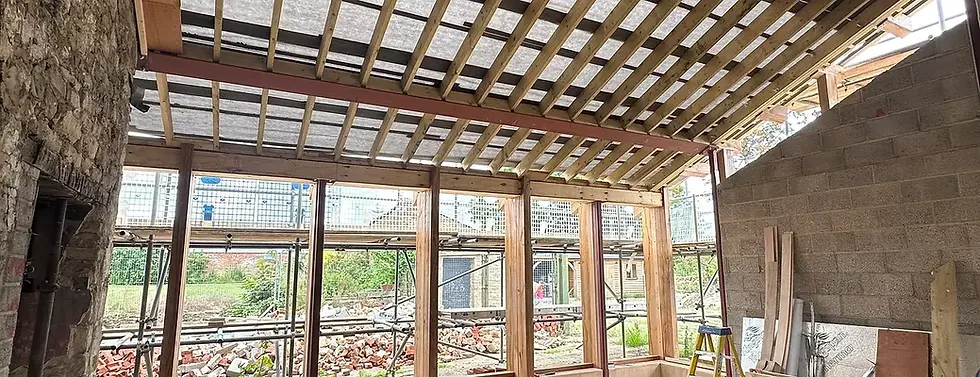
Most people use a rear extension to open up the ground floor. The classic result is a large kitchen, dining and living area all running together, with doors opening straight onto the garden. It sounds unremarkable until you've lived in it. That shift from a cramped galley kitchen and a separate sitting room to one generous, connected space changes everything about how the house works for a family.
That said, back house extensions aren't only about kitchens. We've built ground-floor bedroom suites for clients who can no longer manage stairs, utility rooms that finally give people somewhere to deal with the washing, dedicated playrooms, home offices. The space is yours to decide what to do with. That flexibility is genuinely one of the reasons rear extensions are so popular compared to, say, a loft conversion, where the shape of the roof dictates a lot of your options before you've even started.
Single Storey or Double Storey Back House Extensions: Which Makes More Sense?
This comes up early in almost every project conversation, and the honest answer is that it depends on what you need and what your budget can stretch to.
A single storey rear extension at ground level is the most straightforward route. It's typically quicker to build, easier to get through planning, and for a lot of families it genuinely solves the problem. If what you're after is a bigger, brighter ground floor, a single storey build will usually get you there. Add some decent roof glazing and wide garden doors and the result feels considerably larger than the square footage on paper.
A double storey rear extension is a bigger undertaking but it does give you significantly more for your money in terms of what you end up with. You're gaining space on both floors, usually an extra bedroom or bathroom upstairs alongside the living space below. If you've got a growing family and bedrooms are already stretched, going up as well as out can solve two problems in one project. It will always need full planning permission though, and the structural complexity is greater, so it's worth going in with realistic expectations about timescale and cost.
Planning Permission: Where Most People Get Confused
It's the question we hear more than any other, and it genuinely isn't as frightening as people assume, though it does need careful attention.
A good number of single storey back house extensions can be built without a full planning application under what's called permitted development. The limits are roughly 3 metres beyond the original rear wall for terraced and semi-detached properties, and 4 metres for detached homes, though these figures come with conditions around height and materials that are worth understanding properly before you assume you're in the clear. However do not worry if you are not sure, our team can help figure out what will work best for your property.
There are situations where permitted development doesn't apply at all. Conservation areas are the main one we encounter around here. If your property sits within one, or if it's a listed building, or if a previous planning condition has removed your PD rights, you'll need to go through a full application regardless of how modest the extension is. Flats are excluded entirely.
Double storey extensions always need planning permission, full stop. The council will look at how it affects neighbouring properties, whether it causes overshadowing or overlooking, and whether the design is in keeping with the area.
It's also worth knowing that planning permission and building regulations approval are two entirely separate things. Building regs cover the structural and technical side, insulation, drainage, fire safety and so on, and they apply to almost all extension work. We manage this as part of our process so nothing gets missed, but it's good to understand that it's a distinct step.
If you're not sure which rules apply to your specific property, get in touch with us before you go too far down the planning road. It's a quick conversation that can save a lot of wasted effort.
What Does It Cost?
We always prefer to have an honest conversation about this rather than give figures that turn out to be misleading.
For a single storey rear extension in our area, a reasonable starting point for a straightforward build with decent but not extravagant finishes is somewhere in the region of £50,000 to £80,000. Larger footprints, more complex rooflines, premium glazing, high-spec kitchens fitted within the space, all of these push the number up. A double storey build is a meaningfully bigger investment again.
What often catches people off guard is everything around the build cost. Structural engineer fees, building regulations applications, party wall agreements with neighbours where required, any landscaping to sort out afterwards. These aren't optional extras but they don't always appear in early budget conversations, so it's worth asking about them upfront.
The flip side is the value a well-built extension adds to your home. A good rear extension typically adds more to your property's value than you'd lose to estate agents and stamp duty if you moved instead. It's not the only reason to do it, but it's a reasonable way to think about where the money goes.
Getting the Design Right
One of the things we spend a fair amount of time on early in a project is making sure the design actually solves the problem the homeowner has, rather than just adding square footage.
A few things that consistently make rear extensions work well: getting the ceiling height right, thinking carefully about where the natural light comes from at different times of day, and making sure the connection to the garden feels deliberate rather than tacked on.
Bifold and sliding doors across the back of an extension are popular for good reason. When the weather allows it, throwing those open changes the atmosphere of the whole ground floor. Roof lights and lanterns do similar work on overcast days, which in the East Midlands is most of the year. A flat roof extension with a well-proportioned lantern can feel light and open in a way that surprises people who were expecting something darker.

For period properties, an orangery sits very naturally at the back of the house, with its solid walls, large glazed panels and lantern roof. We completed an oak-framed orangery extension at the Old Rectory in Haversham that's a good example of how that approach works on the right building. It's worth having a look at our recent projects if you want to get a feel for what different approaches actually look like finished.
Why the Builder You Choose Matters More Than People Think
There's a version of this process where you get plans drawn up, find someone cheap on a comparison site, and hope for the best. We see the results of that fairly regularly, and it's rarely pretty.
Rear extensions involve proper structural work. The design affects your drainage, your existing foundations, your party walls. Corners cut during the build don't always show themselves immediately, and by the time they do, fixing them is expensive.
Astrum Construction is a privately owned business, accredited by TrustMark, CHAS and the Federation of Master Builders. We manage projects from the initial conversation right through to handover, which means you're not trying to coordinate an architect, a structural engineer and a builder yourself. We cover Milton Keynes and the surrounding areas across Buckinghamshire, Bedfordshire and Northamptonshire, and we're happy to start with a no-obligation chat about what you're thinking.
If you're weighing up back house extensions for your home, the extensions page on our website gives a good overview of what we do, or you can download our brochure if you'd like something to look through at your own pace. Either way, you can contact us through our online contact form when you're ready and we'll take it from there.


Comments